On July 14, 2025, the European Commission published in its Official Journal the revised Regulation (EU) 2025/1399 on POPs, which will enter into force on August 3, 2025.
The key control limit requirements for PFOA, its salts, and related substances remain unchanged in this revision. For substances, mixtures, and articles, the PFOA and its salts must be less than or equal to 0.025 mg/kg, and the combined total of PFOA-related substances must be less than or equal to 1 mg/kg. The list of prohibited and restricted substances in the EU POPs regulation remains at 30 items.
Comparison of the revised regulation on perfluorooctanoic acid (PFOA), its salts, and related compounds with the current regulation
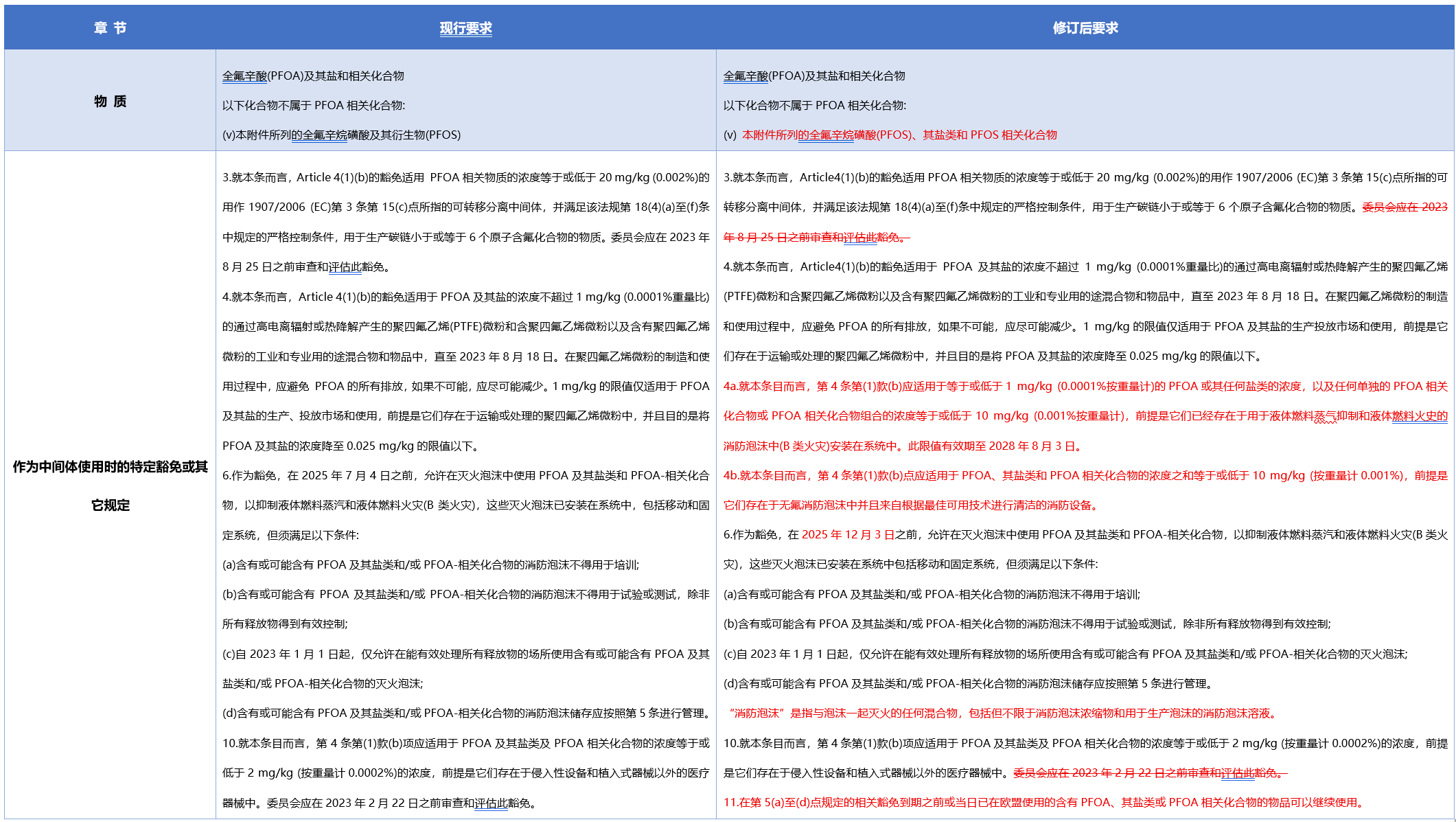
Main revisions are as follows:
◆ Revision of point 3: Delete the second sentence above.
◆ Addition of points 4a and 4b above.
◆ Revision of Point 6: Replace the exemption date from "July 4, 2025" with "December 3, 2025"; and add a definition of "firefighting foam" at the end.
◆ Revision of Point 10: Delete the second sentence above.
◆ Add the above Point 11.
About PFOA
Perfluorooctanoic acid (PFOA) is a synthetic perfluorinated compound and a key member of the perfluoroalkyl and polyfluoroalkyl substances (PFAS) family. It is highly stable and, along with its excellent surface activity, imparts oil and water repellency, stain resistance, chemical resistance, and high-temperature resistance to products. It has been widely used in industrial and consumer products such as firefighting, electroplating, food packaging, textiles, and semiconductors.
About POPs Regulations
Persistent organic pollutants (POPs) are human-generated organic chemicals that persist in the environment, have a long half-life, can accumulate through the food web, and can cause adverse effects on human health and the environment. They can cross international borders via the atmosphere, water, or migratory species, reaching regions where they are not previously produced or used (e.g., from Asia to Antarctica). Therefore, global risk management is necessary, as no region can manage the risks posed by these substances alone.
The EU POPs Regulation, Regulation (EU) 2019/1021, regulates persistent organic pollutants (POPs). This regulation aims to phase out or ban the production, sale, and use of POPs listed in the Stockholm Convention on Persistent Organic Pollutants (POPs) in the EU as soon as possible, thereby protecting humans and the environment from the harmful effects of POPs and minimizing their release into the environment.
Warm Tips
The EU POPs Regulation is frequently updated and enforcement is increasingly stringent, resulting in numerous cases of POPs violations. ZRLK recommends that relevant companies closely monitor regulatory developments and develop control measures to mitigate the economic losses caused by POPs violations. Our company has a wide range of testing areas and a professional and efficient service team. We can help companies evaluate the specific chemical substances regulated in their products so that your products meet the standards of relevant national and international organizations. If you need any help, please feel free to contact us and our engineers will serve you as soon as possible!